
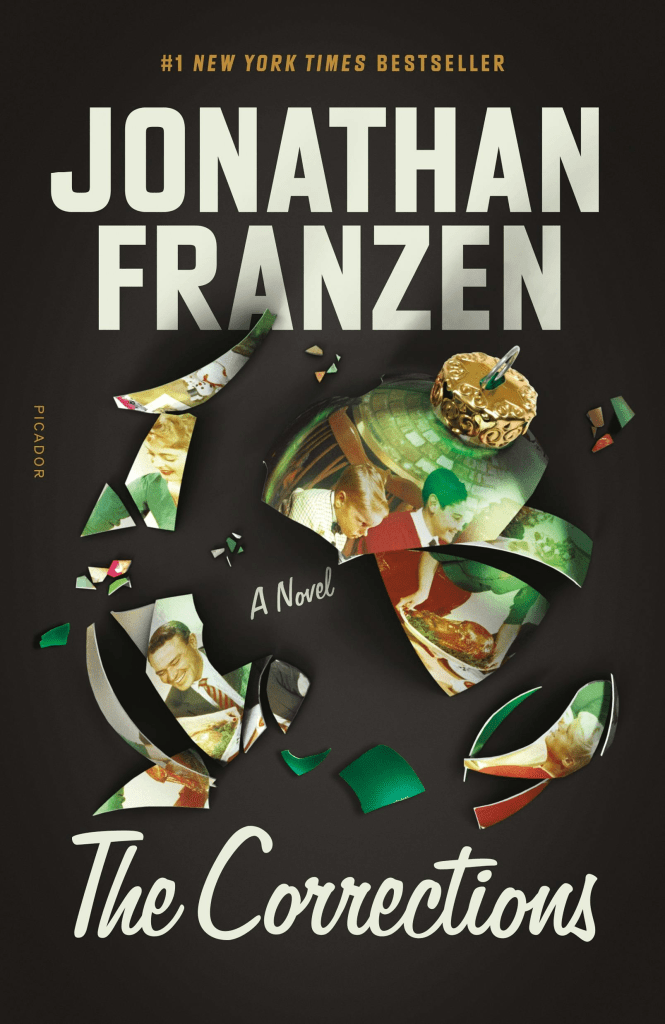
The Corrections

Here’s another novel from the recent NY Times List of “Greatest Books of the 21st Century.” It’s almost 600 pages long, and, given how weighty and dense and serious it is as a work of fiction I was surprised to find the writing quite breezy. I laughed heartily several times and regretted my decision 20-odd years ago to classify Jonathan Franzen as merely one of a crop of young writers at the time whose voices and themes and styles all seemed indistinguishable to me: Safran-Foer, Lethem, Chabon, Schteyngart, etc. I thoroughly enjoyed The Corrections.

I must however admit that the family at the center of the novel is deeply troubling. Most of the characters are eminently likeable and relatable–I found much in the family interactions which was all-too-familiar from my own experiences. And yet every character does hateful, despicable, awful things. Again, pretty typical of my experience not only of my own family but also of others I know well. This is where the sophistication of the book lies: documenting a time period in US/world history via the lives of a single midwestern family teetering on the brink of total and utter disarray and giving us a full picture of why across three generations. Franzen’s book shows us lovable people who we want to care for despite how truly terribly they behave–and given where American society has gone since its publication there is a bit of prescience in his vision. The entire nation these days feels like a dysfunctional family full of badly behaving people who are at heart decent and reasonable but whose unpredictable, selfish, and greedy behavior makes them despicable.

This morning I read an essay by Wallace Shawn in the NY Review of Books. The essay, called The End of a Village, will serve as the introduction to a newly re-issued book about the Vietnam War. Shawn was a college pal of the author Jonathan Schell, and manages to paint an evocative portrait of his friend and what he hoped to achieve through reporting on The Village of Ben Suc. Schell observed the complete and utter destruction of a peasant village by US forces, and tried to portray both the victims of this assault and the perpetrators with as much objectivity as he could muster. Having just finished The Corrections, I was struck when Shawn wrote this about Schell: “He generally seemed to like the military men he encountered. It’s just that what they were doing was appalling.”

This of course leads us to Hannah Arendt in The New Yorker 50-some years ago and her “banality of evil” (Wallace Shawn’s dad was managing editor of The New Yorker at the time). Shawn makes the connection, stating “If one accepts the idea that the ugliest of crimes can by perpetrated by people who aren’t ugly criminals, then the possibility seems to arise that even reasonably nice people might be at times involved in evil.”

The characters in The Corrections do horrible things as their family dangles by a frayed thread over the abyss of the 21st century. But at different parts of the novel, told from their different perspectives, I found myself rooting for each of them and caring deeply about their situations despite the decisions they made. And if individuals can do horrible things despite being “good” people, then so of course can societies and nations.

So we all make poor decisions and we all allow questionable motivations to drive us now and again. But how do we fix things after? When we go catastrophically awry and cause catastrophe, what is the means of repair? The word corrections has a lush ambiguity because the word has so many applications. A teacher corrects her student’s work. Parents correct their children (well, ideally). Some behavior is considered correct, and society drills us in the niceties of acceptable interactions. A captain who discovers her ship is off course will make corrections, a market which is overheated will face an inevitable correction. All of these senses of the word have a similar basis but different nuances. Every generation goes through a reaction to what was considered correct by the previous, now aging members of a family or civilization. So what is correct can be in flux, and those doing the correcting can be wrong or misled or mal-informed. When everything is called into question, when religion, government, the media, when public institutions previously held in high regard, when family itself all face skeptical and factual analysis and are thereby doubted and eventually shorn of their importance, and when much of the traditional underpinnings of a society and its very history are demonstrated as false and hypocritical, what is left? Where can we turn for guidance and support? How do we rebuild? I guess we’ll find out together.
The Relation of My Imprisonment (Part 1)

On Friday December 15th I was riding high. We’d been to the Prefecture in Tulle the day before in order to retrieve our renewed visas–applying was a somewhat arduous process which took almost six months, and we were quite pleased to find our renewal was not only for one year, but for four.

We’d had a successful year with our gite rental business, and had also expanded to host several successful events including multiple concerts and a huge Christmas Festival. We were considering maybe getting away for a week to explore a new part of Europe to celebrate. All in all, our move to France appeared to be going quite well 1.5 years in.

We went to the Treignac Christmas market and ran into friends outside the Salle de Fete, and after a quick tour of the vendors decided to go to Cafe du Commerce for a quick coffee. As we made our loop around the market I’d had a strange kaleidescopic prism worm its way across the top of my left eye, after which I felt a bit out of sorts–a tad tired and grumpy. I chalked it up to being spent after so many days in a row of work and stress, and continued on my way.

At the Cafe we had a wide-ranging conversation about spirituality and shamanism and drugs and Jesuits and life on an Indian ashram. I’d continued to feel a bit out of sorts and then realized that I was having trouble forming words. I finished my point speaking to the Irishman to my left and remember thinking “well, just stop talking. Be polite and nod and smile, but take a rest from speaking.” I’d only had a coffee to drink, but felt as though I were intoxicated. I could see everyone and was able to follow the social niceties, nodding appropriately, smiling, laughing a few times, but I realized that the conversation had grown beyond my capacities to follow. My awareness, my conscient core, was shrinking rapidly. Everything grew dim, and the people around me were all faceless. I could only recognize their hair, it was too much to decode their faces. A friend across the table was speaking to me directly and I knew I was being addressed but had no idea what he was saying. He handed me his phone to show me something, I took it and mimed looking at it, and nodded, but could see nothing on the screen. I felt like I was becoming smaller and smaller, and yet my main concern was an adamant focus on not alarming anyone or causing some sort of scene.

I took out my own phone to occupy myself and found that I couldn’t read or understand its function. I leaned over to my wife and said something about “all these messages, I don’t understand them, who is messaging me” but I couldn’t hear what she was saying in reply and did not even know for sure if I’d spoken.

Another friend arrived and joined our group. I reached over and shook his hand and smiled but had no idea who he was. At this point I realized there was a dog at the table but I had no idea how it had got there, and then looking around I discovered that I didn’t know anyone’s names. I sat back down and my wife was saying something and clutching my arm and suddenly I snapped back to myself. She was saying “I’m taking you to the emergency room, you’ve had a stroke!”

My full awareness returned so suddenly and all at once that I responded indignantly “what are you talking about, I’m fine!” But as I stood to pay our bill I staggered a bit, and then could not summon the basic French to interact with the bartender. I managed to pay and walk out and the entire time my wife was hammering me about going to the Emergency Room, but I felt completely fine. I drove us home, where she kept telling me names of people I didn’t recognize at the bar, and I kept saying that either I didn’t know such a person or that they hadn’t been there. She got very frustrated with me and called our German friend who drove over to assess me himself. After he left thinking I was OK I drove us back to the friend’s house where we were staying while we babysat their hound dog. I fed the dog, let him out, and played with him, and then the entire episode came back to me. The confusion, the sense of shrinking awareness, the inability to follow or participate in a conversation, not recognizing familiar people.

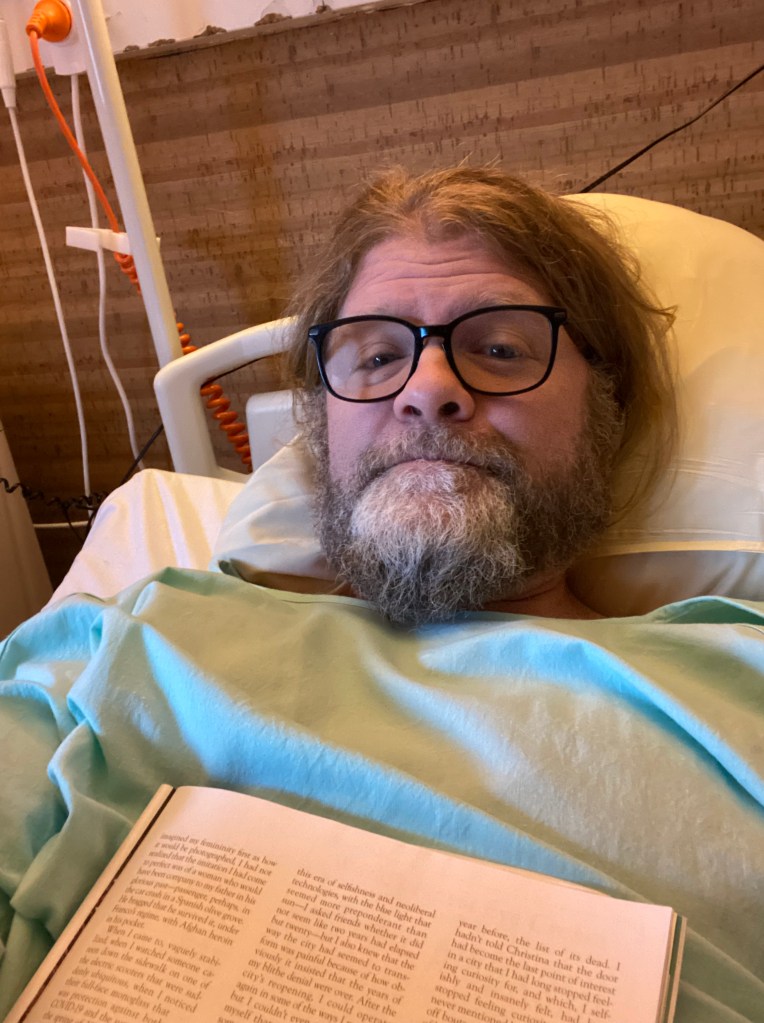
I agreed to go to the ER in Tulle, and after explaining in French what had happened, was quickly taken in the back, given an EKG and an MRI and told that the results were normal/negative. I thought “Ok, no stroke, no aneurysm, I’ll be on my way!” But no, they took me upstairs, admitted me and kept me 8 days in the hospital.

(End of Part 1)

The Smoking Jacket

Vashi’s of Bangkok, Thailand

Yesterday was rainy much of the day, and I was unable to go out and be productive in the garden for the first time in a week. I sat around reading and daydreaming, and at one point a memory hit me.

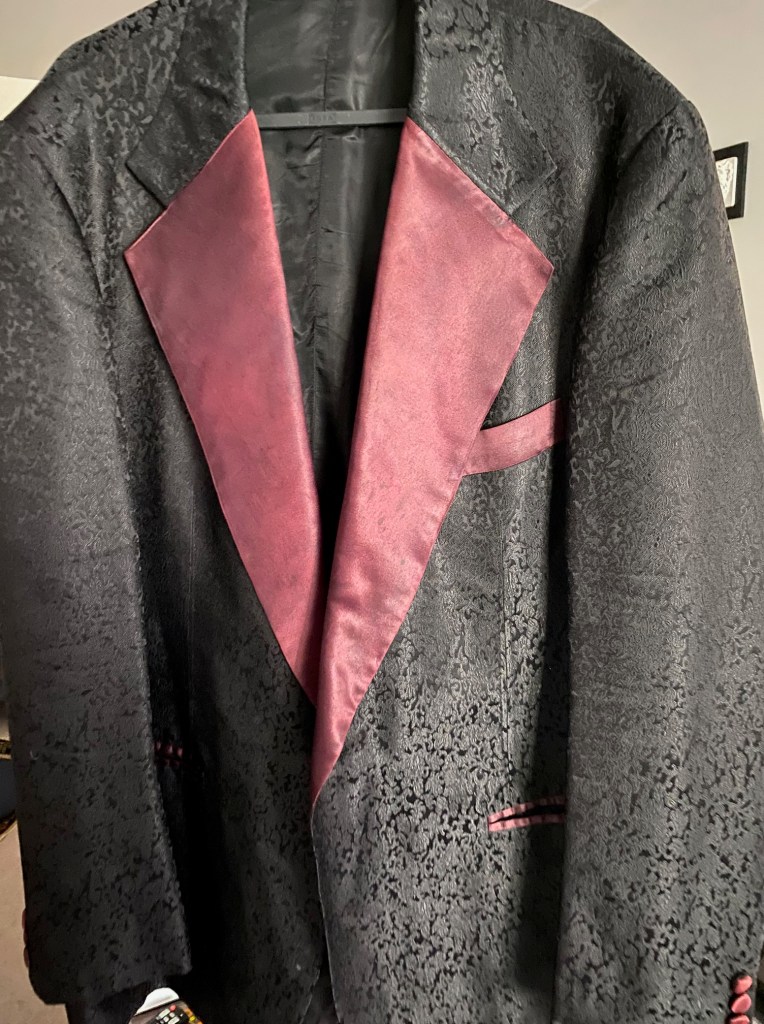
I have an old dark lavender smoking jacket of high quality make and material. It’s the kind of garment one can rarely wear unless he is a fop or a dandy. I tend toward jeans and T-shirts for the most part, but have worn this jacket over the years to certain events, typically as part of a costume, or to New Year’s parties. When we moved away from the USA 5 years ago, I put the coat in my mother’s house in her guest room closet. I only fetched it last January when we were home for the holidays.

The jacket was given to me by a long-time friend from whom I’ve lately become estranged. He purchased it when he was in the throes of major substance addiction, and gave it to me when he became sober. Ironically, I used to keep illicit substances wrapped in plastic or foil in the pockets of this jacket. This was the memory which suddenly hit me: what if I’d concealed something in those jacket pockets and forgotten? Imagine the situation at customs upon our arrival in France!

Naturally I had to go rummage around in the jacket pockets just to be sure. There was nothing, but while I poked and prodded and carefully probed the pockets both interior and exterior of this old garment, and in between memories both fond and otherwise of the friend who’d gifted it to me, I was hit by a delicious idea for a short story.

I’d not had an idea for a short story in 15 years. I’ve not written one for longer than that. Perhaps my long-dormant muse is awakening?